
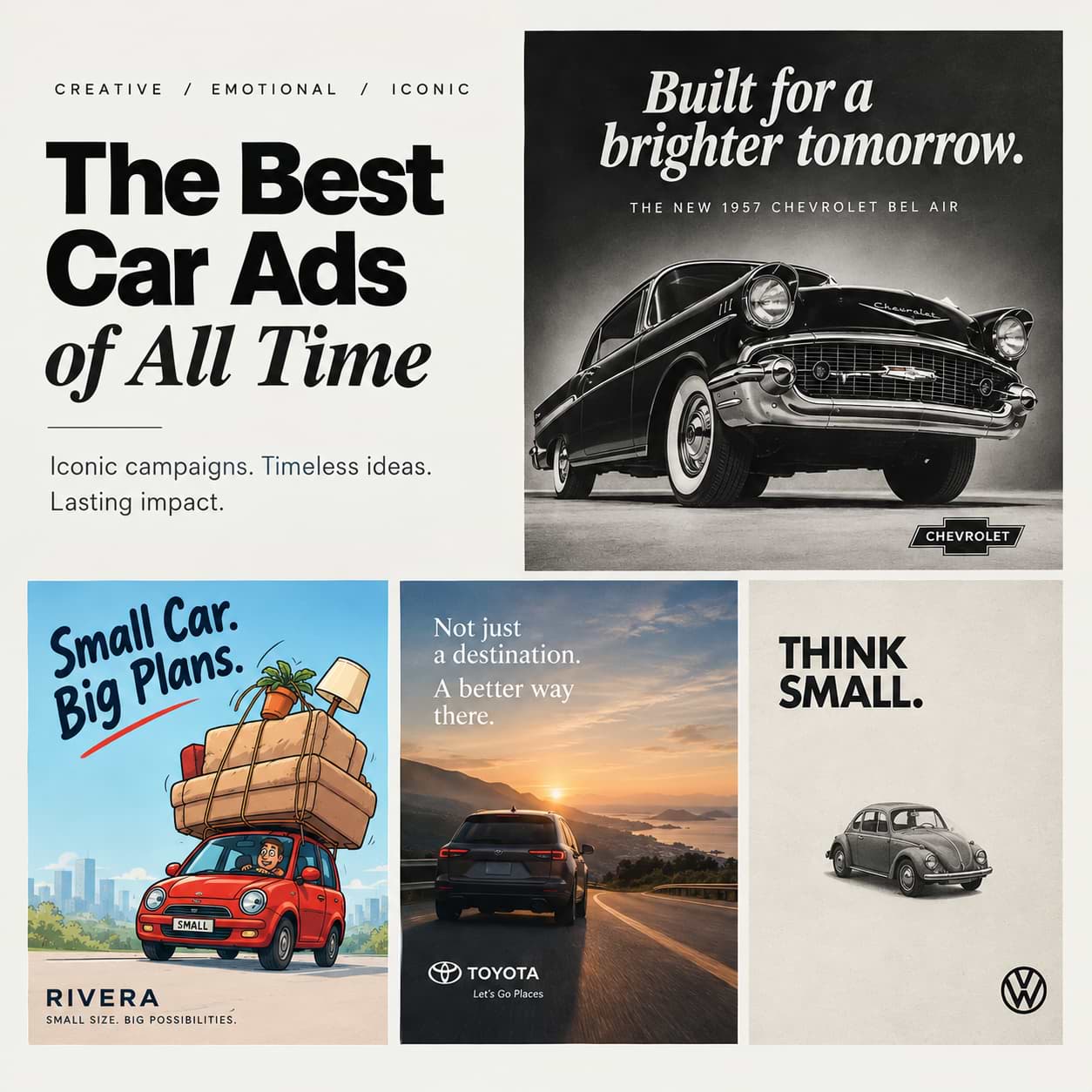
Car ads have always had to do more work than most categories — they’re selling a five-figure decision, not an impulse buy, which is exactly why the category has produced some of advertising’s most technically ambitious and emotionally sharp car advertisements ever made. This guide walks through the best examples, how to build your own — whether for a real listing, a school project, or an AI-generated concept — and answers the questions people actually search around car ads.
Best Car Ads of All Time
A handful of car campaigns get cited again and again in advertising case studies, because each solved the same basic problem — making a mechanical object feel emotionally meaningful — in a genuinely different way.
1. Volkswagen — “Think Small” (1960)
While American car ads of the era leaned on size and horsepower, Volkswagen’s print campaign for the Beetle embraced minimalism and self-deprecating honesty, turning the car’s small size into its entire personality. It’s widely credited with inventing the modern “less is more” school of advertising.
2. BMW — “The Ultimate Driving Machine”
Decades of consistent positioning around performance and precision built one of the most recognizable taglines in the automotive category, reinforced through print, TV, and motorsport sponsorship rather than a single standout execution.
3. Volvo Trucks — “The Epic Split” (2013)
Jean-Claude Van Damme performing a full split between two reversing trucks to demonstrate Volvo’s Dynamic Steering system became one of the most-shared branded videos of its decade, proving a genuinely surprising stunt can outperform a traditional product demo by a wide margin.
4. Honda — “Cog” (2003)
A single unbroken shot of Honda Accord parts triggering a chain reaction — no cuts, no CGI — took over 600 takes to get right and remains one of the most awarded car commercials ever made, all built around the simple idea that “isn’t it nice when things just work.”
5. Audi — “Vorsprung durch Technik”
Decades of clean, engineering-focused advertising relied on precise product photography and a single German tagline to build a reputation for technical superiority that needed almost no further explanation.
6. Volkswagen — Porcupine Between Goldfish Bags
A porcupine parked with pinpoint precision between two fragile bags of goldfish demonstrated a parking-assist feature far more memorably than a specification sheet ever could.
7. Volkswagen Touareg — The Shaved Mountain Goat
A mountain goat’s back shaved into a poodle-style trim blended off-road capability with luxury grooming in a single sharp visual, proving a print concept doesn’t need to show the car at all to make its point.
8. Mercedes-Benz — Crash-Test Silhouette Series
Long-running print work focused on safety engineering used minimal graphics to illustrate crumple zones and structural integrity without requiring a single photograph of the actual vehicle.
9. Fiat — “Fear the Squirrel”
A driver terrified of a tiny squirrel outside the city poked fun at how disconnected urban life can make people from nature, a print gag that doubled as the car’s “get outdoors” positioning.
10. Opel — Blurry Texting Type
Deliberately garbled, hard-to-read typography mimicked what a text message looks like when typed while driving, connecting poor typing directly to road danger with dark comic timing.
11. Ford — Rear-View Camera Selfie Dog
A dog staring directly into a rear camera evoked the warmth of the feature with an emotionally engaging, almost accidental “selfie,” proof that a genuinely charming visual can outperform a straightforward feature demo.
12. Jeep — Giraffe/Penguin Optical Illusion
An optical-illusion print execution flipped from a giraffe to a penguin depending on orientation, rewarding the viewer with a second look and reinforcing Jeep’s “go anywhere” positioning through pure visual wit.
13. BMW M3 — The Flash’s Hand on the Wheel
A superhero known purely for speed shown gripping the steering wheel linked the car’s performance to an instantly recognizable icon, letting the association do the selling instead of a spec list.
14. Honda Motorcycles — Maze Traffic
A tangled maze of gridlocked cars contrasted with a motorbike’s ability to weave straight through, visualized as literal maze-solving — a simple metaphor that needed no further explanation.
15. Škoda — “Made of Metal” Cake Campaign
A giant car-shaped cake was baked and then carved down to reveal a real Škoda Fabia hidden inside, a genuinely bizarre stunt that racked up millions of organic views purely on novelty and craftsmanship.
16. Chevrolet — “Like a Rock” (with Bob Seger)
A decade-long campaign paired durability-focused truck imagery with Bob Seger’s already-nostalgic anthem, showing how a well-chosen soundtrack can become as central to a car campaign as the visuals themselves.
17. Subaru — “Dog Tested. Dog Approved.” (The Barkleys)
An entire animated ad series starring a family of golden retrievers driving, parking, and reviewing Subaru safety features turned a mundane category — car safety — into a genuinely beloved, ongoing mascot-driven story.
18. Mini Cooper — “Not Normal” Campaign
Cheeky, self-aware billboard and print copy leaned into the Mini’s small size and quirky personality rather than apologizing for it, extending the same “smaller can be better” instinct Volkswagen pioneered decades earlier.
19. Toyota — “Let’s Go Places”
A broad, optimistic tagline built around possibility rather than a single feature gave Toyota’s global advertising a flexible emotional umbrella that could stretch across trucks, hybrids, and family sedans alike.
20. Land Rover — Heritage and Adventure Print Series
Decades of rugged, expedition-style photography tied Land Rover’s identity to genuine off-road exploration rather than urban luxury, reinforcing durability through lived-in, dust-covered imagery instead of showroom polish.
Used Car Advertisement: How to Write One That Actually Sells
Selling a used car is a different job than a brand campaign — there’s no budget for a stunt or a jingle, just a listing competing against dozens of others on the same marketplace page. A good used car advertisement still borrows the same core discipline as the campaigns above: lead with the one detail a buyer actually cares about first.
- Headline with the essentials. Year, make, model, and mileage in the first line — buyers skim listings fast, and a vague headline gets scrolled past.
- Lead with condition, not adjectives. “One owner, garage kept, full service history” tells a buyer more than “great car, must see.”
- Be upfront about flaws. Listing a minor issue (a small scratch, an aging battery) builds more trust than a buyer discovering it at pickup — and cuts down on wasted viewing appointments.
- Use natural light photos, multiple angles. Exterior from all four corners, interior, odometer reading, and engine bay — listings with more genuine photos consistently get more serious inquiries.
- Price clearly, and note if it’s negotiable. “OBO” (or best offer) or a firm price both work — an unclear or missing price is one of the fastest ways to get skipped over.
- End with a simple, low-friction call to action. “Message to arrange a viewing” or “Call after 5 PM” removes ambiguity about the next step.
Example listing: “2018 Honda Civic LX, 62,000 miles, one owner, non-smoker. Regularly serviced, new tires in 2024, small scratch on rear bumper (photo included). Runs great, no mechanical issues. $14,500 OBO. Message to schedule a test drive.”
Car Advertisement Poster
Some of the smartest car advertising never moved at all. A single still image, done well, can communicate a feature faster than thirty seconds of video.
Volkswagen — Porcupine Between Goldfish Bags
A porcupine parked with pinpoint precision between two fragile bags of goldfish demonstrated a parking-assist feature far more memorably than a spec sheet ever could.
Volkswagen Touareg — The Shaved Mountain Goat
A mountain goat’s back shaved into a poodle-style trim blended off-road capability with luxury grooming in a single sharp visual — proof that a car advertisement poster doesn’t need to show the car at all to make its point.
Mercedes-Benz — Crash-Test Silhouette Series
Long-running print work built around safety engineering used minimal graphics to demonstrate crumple zones and structural integrity without requiring a single photograph of the actual vehicle.
Fiat — “Fear the Squirrel”
A driver terrified of a tiny squirrel outside the city poked fun at how disconnected urban life can make people from nature — a print gag that doubled as the car’s “get outdoors” positioning.
Car Advertisement for School Project
If you’re building a car advertisement for a school project — a marketing class assignment, a design portfolio piece, or a mock ad campaign — the goal isn’t a real budget or a real client, it’s demonstrating that you understand how a genuinely effective ad is built. Here’s a simple structure that works well for grading rubrics and portfolio pieces alike:
- Pick one real feature to sell. Fuel efficiency, safety, towing capacity, or price — choose one, not all four. The strongest real car ads (see the examples above) almost always focus on a single idea.
- Choose a format. A print poster is usually easiest for a school project — it forces you to communicate visually rather than relying on a script.
- Write one strong headline. Something short, ideally with a pun, contrast, or unexpected angle — “Think Small” is five decades old and still the gold standard reference point for this exercise.
- Design around the headline, not the car. As the Porcupine and Goat examples above show, the strongest car ads often barely show the vehicle itself.
- Include a simple tagline and logo placement at the bottom, mimicking real ad layout conventions your teacher or professor will recognize.
For further inspiration on structure and tone, our 100+ best print ads of all time roundup is a useful reference for how professional print concepts are typically laid out.
Car Advertisement Prompt: Ideas for AI Image Generation
If you’re using an AI image generator (Midjourney, DALL-E, or similar) to mock up a car advertisement concept, a good car advertisement prompt needs the same ingredients a real creative brief would: a clear subject, a mood, a lighting style, and a format. A few starting-point prompt structures:
-
“Minimalist print advertisement for a compact car, single vehicle centered in large white negative space, small bold headline at bottom-left, 1960s advertising style, clean typography” — modeled on the “Think Small” approach.
-
“Dramatic automotive advertisement, car silhouette against a sunset on an open highway, cinematic lighting, tagline space at the bottom, magazine advertisement layout” — for a more aspirational, lifestyle-driven concept.
-
“Studio product shot of a car’s dashboard and steering wheel, close-up detail, luxury advertising style, soft reflective lighting, minimal text overlay” — for a feature-focused, close-up interior ad.
The same rule from real advertising applies to AI-generated concepts too: describe one clear idea in the prompt rather than trying to cram multiple features or moods into a single image.
Funny Car Ads Worth Knowing
Humor remains one of the most reliable tools in car advertising, since it lowers the guard of an audience that’s usually being pitched a major purchase.
Opel — Blurry Texting Type
Deliberately garbled, hard-to-read typography mimicked what a text message looks like when typed while driving, connecting poor typing directly to road danger with dark comic timing.
Ford — Rear-View Camera Selfie Dog
A dog staring directly into a rear camera evoked the warmth of the feature with an emotionally engaging, almost accidental “selfie” — proof that a genuinely funny, low-key visual can outperform a straightforward feature demo.
Jeep — Giraffe/Penguin Optical Illusion
An optical-illusion print execution flipped from a giraffe to a penguin depending on orientation, rewarding the viewer with a second look and reinforcing Jeep’s “go anywhere” positioning through pure visual wit.
Final Thoughts
Whether it’s a decades-old Volkswagen print ad, a viral Volvo truck stunt, or a car advertisement built for a class assignment, the same principle holds across every example above: the strongest car ads sell one clear idea — safety, simplicity, adventure, precision — rather than trying to list every spec on the window sticker. That discipline is what separates an ad people remember from one they scroll past.
Frequently Asked Questions (FAQs)
1. How to write an advertisement of a car?
Start by picking one clear selling point — price, mileage, condition, or a standout feature — rather than listing everything at once. Lead with a short, attention-grabbing headline, follow with 2-3 concrete details (year, mileage, key features), include a clear call to action (contact info or “message to view”), and add a genuine photo. For a class project or creative ad rather than a real listing, the same rule applies: one idea, communicated clearly, beats a crowded pitch.
2. What are the best car ad slogans?
Some of the most recognized car ad slogans include BMW’s “The Ultimate Driving Machine,” Audi’s “Vorsprung durch Technik” (“Progress through Technology”), Toyota’s “Let’s Go Places,” Volvo’s long-running safety-first positioning, Chevrolet’s “Like a Rock,” and Ford’s “Built Ford Tough.” Each works because it ties directly to one consistent brand trait rather than a rotating feature list.
3. What is the best caption for a car?
For social media, short and punchy tends to perform best — something like “Built for the drive, not just the destination,” “New wheels, same me,” or “Some things just hit different in the driver’s seat.” The best caption depends on tone: playful for a personal post, feature-focused (“Zero to sixty, all business”) for a dealership or brand account.
4. What is Gen Z slang for cars?
Common Gen Z car slang includes “whip” (a car in general, especially a nice one), “ride” (similar usage), “beater” (an old, worn-down but functional car), and “drip” (used more for styling/customization than the car itself, as in a car “having drip”). Slang shifts quickly, so terms popular in one year can fade fast — always double-check current usage before using slang in official brand copy.
5. Which car is most liked by men?
There’s no single definitive answer, since preference varies heavily by age, income, and region — but automotive industry surveys have repeatedly shown trucks (like the Ford F-150), performance/sports cars, and larger SUVs tend to poll as strong favorites among male car buyers in the U.S. market. Brand loyalty and personal priorities (towing capacity vs. speed vs. styling) matter more than any single “most-liked” model.
6. What is the most-watched car ad ever?
Exact “most-watched” rankings vary by source and platform, but Volvo Trucks’ 2013 “The Epic Split,” featuring Jean-Claude Van Damme performing a split between two reversing trucks, is consistently cited as one of the most-viewed and most-shared car ads in advertising history, having gone viral well beyond its original paid media reach.