
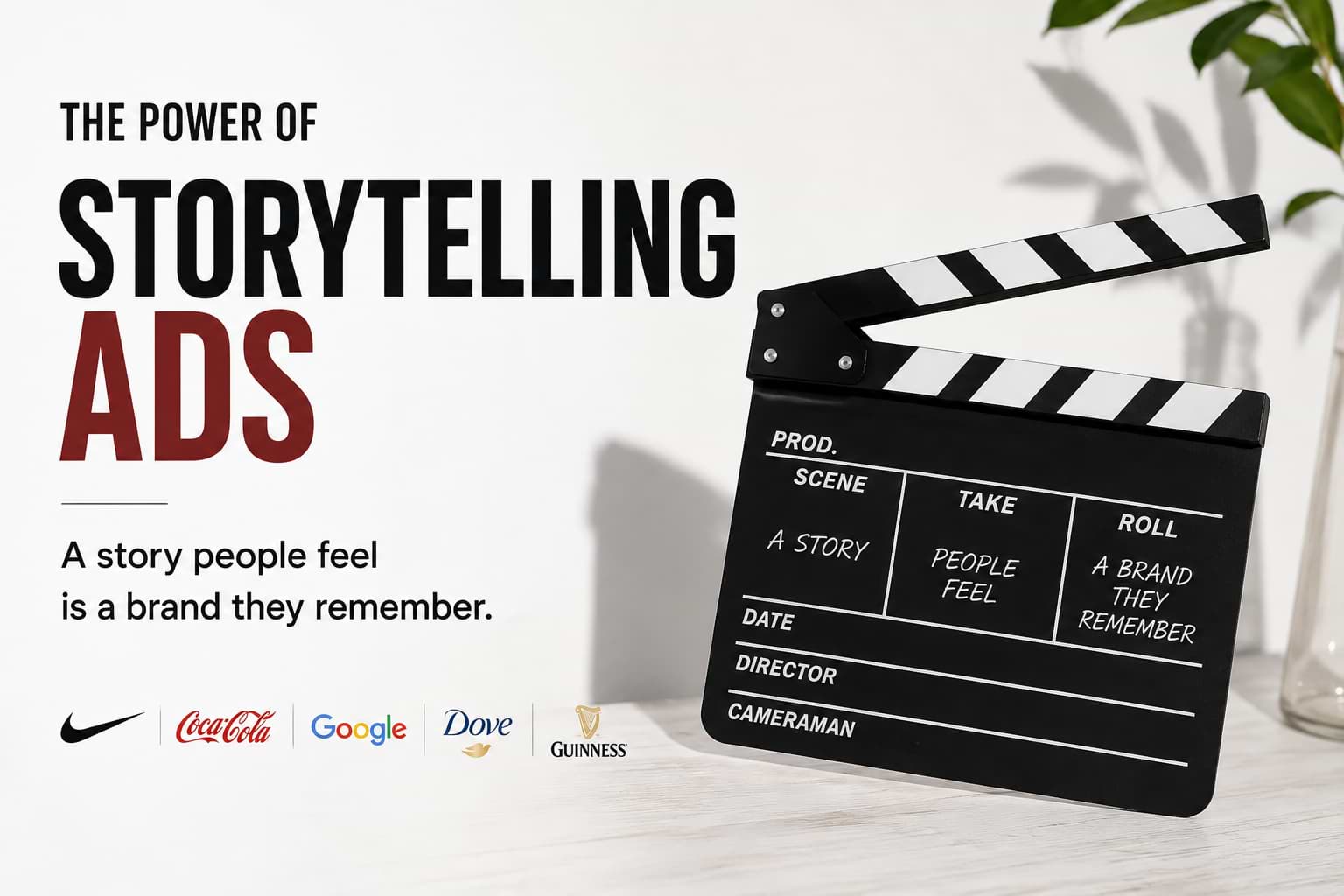
Most people see thousands of marketing messages a week and can’t recall more than a handful by evening. That’s not a failure of attention — it’s what happens when an ad asks to be remembered for information alone. The ads that do stick share one trait: they gave the audience a story, not just a pitch. A character to follow, a problem to resolve, a moment that felt like more than a transaction. That’s the core idea behind storytelling ads, and it’s worth understanding as a specific creative approach — with its own mechanics, its own best examples, and its own common failure points.
What Are Storytelling Ads?
Storytelling ads are advertisements built around a narrative — a character, a conflict, and some kind of emotional resolution — instead of a straightforward list of product features. Rather than asking the viewer to remember a spec or a price, a storytelling ad aims to make them remember a feeling, a situation, or a character connected to the brand.
The difference from a traditional product ad is a difference in what’s actually being sold in that 30 or 60 seconds. A traditional ad sells the product directly. A storytelling ad sells an experience the product is attached to — belief, confidence, nostalgia, relief — and lets the product ride alongside that feeling rather than lead it.
What Is Storytelling Marketing?
Storytelling ads are one execution of a broader discipline: storytelling marketing. Where a storytelling ad is a single piece of creative, storytelling marketing is the strategy of carrying a consistent narrative across every channel a brand touches — advertising, social media, video, websites, email, packaging, and long-form content.
The distinction matters because a single great storytelling ad can still fail as storytelling marketing if the story stops the moment the ad ends. Nike’s “Just Do It” philosophy isn’t confined to television — it shows up in product naming, social captions, athlete partnerships, and retail environments, all reinforcing the same underlying belief.
Why Do Ads That Tell a Story Work?
A few overlapping mechanics explain why ads that tell a story tend to outperform ads that simply describe:
- Emotional connection — feelings tend to precede and shape the decisions that follow.
- Memorability — a narrative gives the brain more to hold onto than a single fact.
- Relatability — a recognizable struggle lets viewers project themselves into the story.
- Curiosity — a well-built story creates tension that keeps a viewer watching.
- Conflict and resolution — nearly every effective ad presents an obstacle before resolving it.
- Character identification — viewers identify with a person, not a product.
- Shareability — people forward stories that made them feel something, not spec sheets.
None of this is a guarantee — audiences vary, and no single technique works in every category. But these are the recurring reasons storytelling campaigns outperform features-first alternatives.
The Basic Story Structure Behind Effective Ads
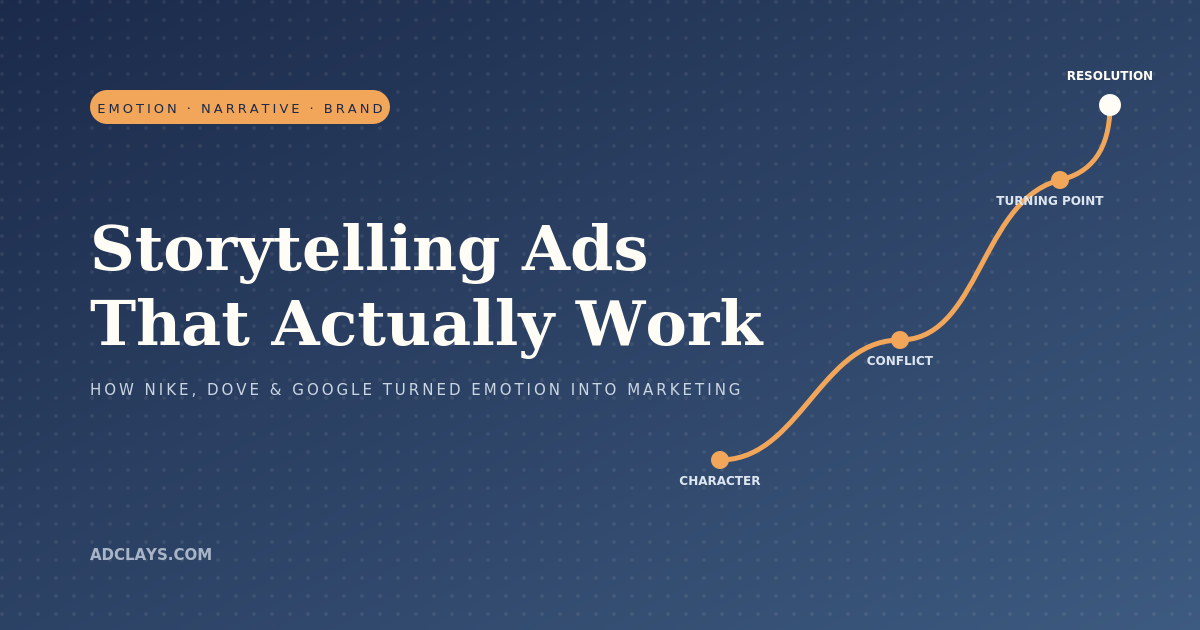
Most effective storytelling ads borrow a simplified version of classic narrative structure:
- Character — someone the viewer can recognize or project onto.
- Problem or conflict — an obstacle or unmet desire.
- Emotional tension — the moment the viewer feels invested.
- Turning point — the moment something shifts.
- Resolution — the conflict resolves, often with the brand in a supporting role.
- Brand/message connection — the idea ties back to what the brand stands for.
Not every successful ad needs all six elements. A campaign built on repetition, like a long-running print series, might skip a traditional plot entirely and tell its story through consistency over time instead.
Best Storytelling Ads Worth Studying
Nike — “Find Your Greatness” (2012)
During the London Olympics, Nike wasn’t an official sponsor — rival Adidas had paid a reported $150 million for that title. Instead of competing on sponsorship spend, Nike built a campaign around ordinary people chasing their own version of athletic achievement, most memorably a 12-year-old named Nathan Sorrell jogging alone down a small-town road at dawn. Lesson: you can out-story a bigger budget by making the audience the protagonist.
Nike — “Dream Crazy” (2018)
Narrated by Colin Kaepernick, this film shows athletes overcoming steep odds, closing on the idea of believing in something even at real personal cost. The product is nearly absent from the frame. Lesson: storytelling ads can carry a cultural point, but that’s a genuine risk, not a guaranteed win.
Nike — “You Can’t Stop Us” (2020)
Wieden+Kennedy combed through more than 4,000 pieces of archival and new sports footage to build a 90-second split-screen film pairing 36 sets of athletes so precisely each pair appears to move as one shot. Lesson: the storytelling technique itself can become the story.
Google — “Parisian Love” (2009)
A minute-long ad told entirely through a sequence of Google searches — narrating an entire relationship using nothing but a search bar. Lesson: a product’s own interface can be the storytelling device.
Dove — “Real Beauty” (2004–present)
Dove replaced airbrushed models with everyday women of varying ages, body types, and skin tones, letting them speak candidly about self-image. Lesson: authenticity is a storytelling technique in its own right.
Coca-Cola — “Share a Coke” (2011–present)
By replacing its own logo with popular first names, Coca-Cola turned a mass-produced bottle into a personal prop people photographed and shared. Lesson: a story doesn’t have to be told to the audience — it can be one they’re invited to write themselves.
Volkswagen — “Think Small” (1960)
A single still image — a tiny Beetle alone in a sea of white space — paired with a self-deprecating headline told an entire underdog story without a single frame of motion. Covered in more depth in our 100+ best print ads of all time roundup.
Guinness — “Made of More”
This platform shifted Guinness’s advertising toward perseverance and quiet resilience, favoring understated visual storytelling over direct product demonstration — one of several campaigns covered in our 60 best beer ads of all time list.
Nike Emotional Storytelling Ads: Why Nike Is So Effective
A few recurring techniques show up across nearly every Nike emotional storytelling ad:
- The audience can identify with the protagonist, whether an overweight 12-year-old jogger or a professional athlete.
- The product is often secondary to the narrative — shoes appear, but rarely as the focus of the shot.
- Emotion comes before features; no Nike storytelling ad opens with cushioning specs.
- The campaigns communicate a larger idea — belief, resilience, unity — beyond any single product cycle.
- The brand maintains a consistent identity across decades of otherwise very different executions.
Smaller brands can’t replicate Nike’s production budget, but they can replicate the discipline: pick a real human tension your audience feels, put the product in a supporting role, and stay consistent across every piece of content — not just the hero ad.
Storytelling Ads vs. Traditional Product Ads
| Storytelling Ads | Traditional Product-Focused Ads |
|---|---|
| Focus on narrative | Focus on features |
| Builds emotional context | Emphasizes product benefits |
| Often uses characters | Often uses product demonstrations |
| Can create brand associations | Can communicate information quickly |
| May prioritize emotion | Often prioritizes functionality |
Neither format is automatically better. A storytelling ad suits brand-building and long-term emotional equity. A traditional product ad often wins when an audience is already close to a purchase decision and simply needs fast, clear information. The right choice depends on the campaign’s actual objective.
How to Create a Storytelling Ad
- Identify the audience — who exactly is this for?
- Find a human problem or desire the audience already recognizes.
- Choose a protagonist the audience can project onto.
- Establish real conflict.
- Build emotional tension before resolving it.
- Introduce the brand naturally within the resolution, not as an interruption.
- Deliver a satisfying, earned resolution.
- End with one clear, memorable message.
- Test different creative executions — the same story can land differently through humor, sentiment, or minimalism.
Common Mistakes in Storytelling Advertising
- The story is more interesting than the brand itself.
- No clear connection between the emotional payoff and the product.
- Too much exposition, rushing the actual payoff.
- Forced emotion that feels manufactured rather than earned.
- Predictable endings the audience saw coming early.
- Copying famous campaigns without the insight that made the original work.
- Trying to tell too many stories in one ad, diluting all of them.
Storytelling Marketing vs. Storytelling Advertising
Storytelling advertising is a single execution — a TV spot, a print ad, a social video. Storytelling marketing is the broader strategy that carries the same narrative across every channel: video, social posts, website content, email, packaging, events, and influencer campaigns. A brand can produce one excellent storytelling ad and still fail at storytelling marketing if that story never appears anywhere else.
Final Thoughts
Storytelling ads work for a simple reason: people don’t remember what a brand told them, they remember how a brand made them feel. Whether it’s Nike attaching itself to human ambition for nearly four decades, Dove replacing airbrushed models with real women, or a single still frame of a tiny car in a sea of white space, the throughline is the same — a character, a tension, and a resolution the brand earns rather than announces. For a broader look at how these principles show up across an entire career of advertising.
Frequently Asked Questions (FAQs)
1. What are storytelling ads?
Storytelling ads are advertisements built around a narrative — a character, a conflict, and some form of emotional resolution — rather than a straightforward list of product features.
2. What is storytelling marketing?
Storytelling marketing is the broader strategy of carrying a consistent brand narrative across every channel — advertising, social media, video, email, and packaging — rather than confining a story to a single ad.
3. What are the best storytelling ads?
Widely cited examples include Nike’s “Find Your Greatness” and “Dream Crazy,” Dove’s “Real Beauty,” Google’s “Parisian Love,” and Coca-Cola’s “Share a Coke” — each using a different storytelling technique.
4. Why is Nike good at storytelling?
Nike consistently places human ambition ahead of product features, uses relatable protagonists, and maintains the same underlying belief — perseverance — across nearly four decades of campaigns.
5. Can small businesses use storytelling marketing?
Yes. It requires a genuine understanding of a real audience problem and consistency in telling that story across whatever channels the business already uses — not a Nike-sized budget.