
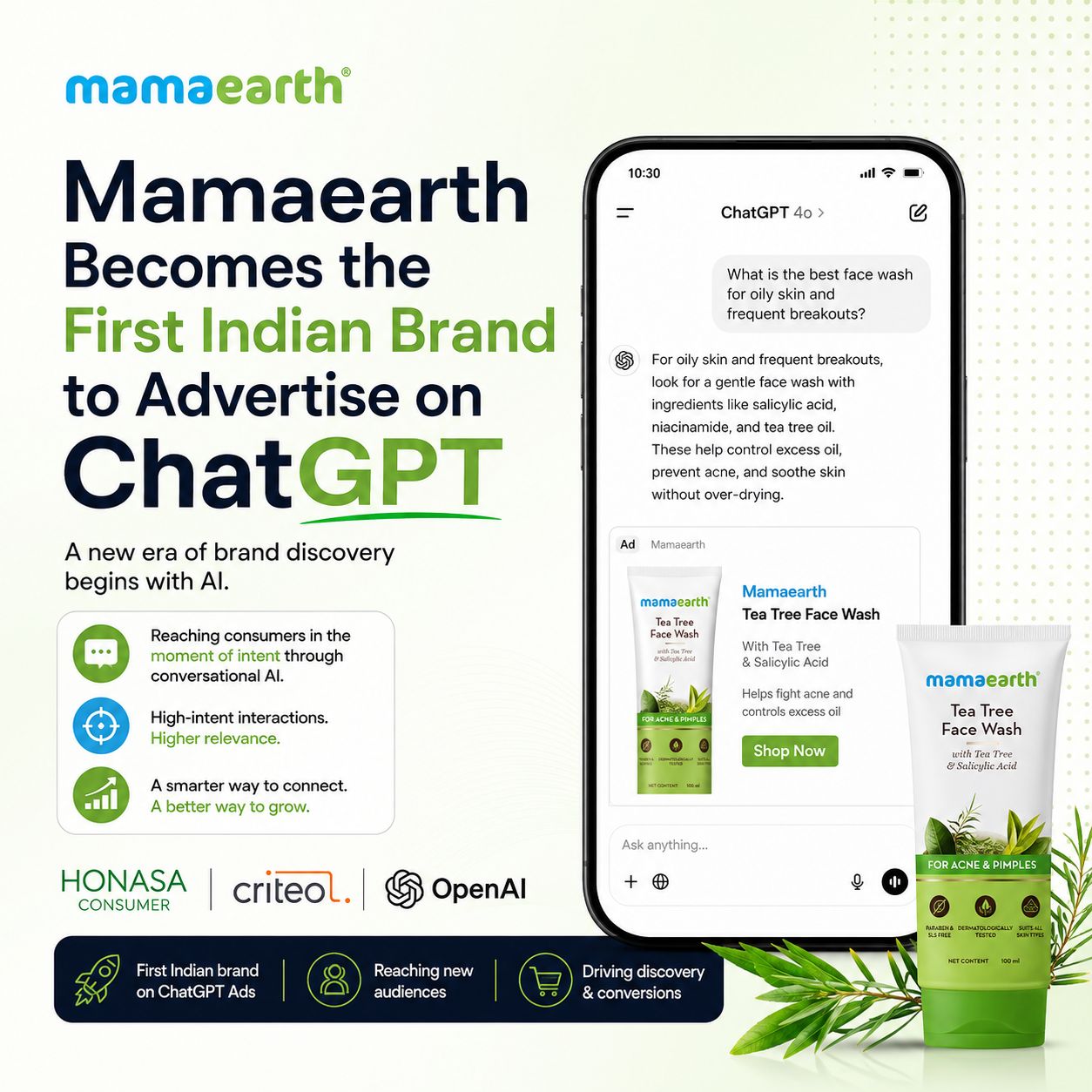
Honasa Consumer’s beauty brand Mamaearth has stepped into a new advertising frontier, becoming, according to its own announcement, the first Indian company to run ads on ChatGPT. The move signals a broader shift in how Indian brands are approaching product discovery as conversational AI increasingly enters the customer research journey.
What Happened
Honasa Consumer has partnered with commerce media company Criteo to advertise Mamaearth on ChatGPT, with co-founder Ghazal Alagh announcing the development on LinkedIn. The partnership follows OpenAI’s expansion of ChatGPT’s advertising service to India, and Criteo’s existing integration with OpenAI allows advertisers to access ChatGPT’s ad inventory as part of their broader digital campaigns.
Alagh framed the move around a shift in consumer behavior: “The way we discover brands is changing and AI is becoming a big part of that change,” she said, adding that Honasa has “always believed that building brands starts with understanding where the consumer is going, not just where they are today.”
ChatGPT’s advertising service is currently shown to logged-in adult users on its Free and Go plans, while Plus, Pro, Business, Enterprise, and Education subscribers don’t see ads. OpenAI has said more than 50 brands were scheduled to advertise on the platform in India during its initial rollout, with WPP and Omnicom serving as the market’s first agency partners. Self-service access to ChatGPT’s Ads Manager in India began on September 4, with daily budgets starting at ₹725.
How the Ad Placement Actually Works
The format places a clearly labelled Mamaearth advertisement beneath ChatGPT’s organic response to a relevant query — for instance, someone asking about oily skin and frequent breakouts might see the AI’s ingredient and routine advice, followed by a labelled ad for a matching Mamaearth product. OpenAI has stated that ads are displayed separately from ChatGPT’s responses and do not influence the answers the assistant generates.
Criteo, which became an advertising technology partner in OpenAI’s ChatGPT advertising pilot back in March 2026, has reported strong early performance data: click-through rates two to three times higher than comparable formats in other environments, and more than 80% of ad-driven ChatGPT traffic coming from new customers. By June, the company said more than 2,000 brands globally were already advertising on ChatGPT through its platform.
Is Mamaearth Really the “First” Indian Brand?
This is the part worth reading carefully. The “first Indian brand” claim comes directly from Honasa’s own announcement — it has not been independently confirmed by OpenAI or Criteo. At least one outlet, The Logical Indian, has explicitly cautioned that Mamaearth should not be described as the first Indian brand on ChatGPT without independent verification of that distinction.
Coverage in Open Magazine put the claim in useful perspective too, noting that the title “may last only until the next brand clicks ‘create campaign,'” given how quickly the ChatGPT advertising rollout in India is expanding across categories. In short: Mamaearth appears to be among the earliest, and is actively marketing itself as the first — but the claim is self-reported, not third-party audited.
Why This Matters for Honasa’s Broader Strategy
Honasa spent roughly ₹241 crore on advertising during the June quarter, making this a meaningful new channel test for a company already investing heavily in marketing. Beauty has reportedly been among the leading categories using ChatGPT’s ad inventory, which may explain why Honasa moved early to secure a first-mover narrative in India’s market, regardless of whether the “first” title holds up to scrutiny over time.
For now, the campaign represents a real test of a genuinely new advertising surface: whether appearing next to an AI’s answer, rather than beneath a search result or social feed, translates into the kind of high-intent purchases Criteo’s early data suggests. As one industry commentator noted, the commercial significance of this shift “remains wonderfully unproven.”
Final Thoughts
Mamaearth’s move onto ChatGPT marks an early, closely watched experiment in how Indian brands adapt to AI-driven product discovery. Whether or not the “first” title survives scrutiny, the bigger story is the shift itself — consumer research is increasingly happening inside conversations with AI rather than traditional search, and brands like Mamaearth are racing to be present at that exact moment of intent.
Frequently Asked Questions (FAQs)
1. Is Mamaearth really the first Indian brand to advertise on ChatGPT?
This claim comes directly from Honasa Consumer’s own announcement, made by co-founder Ghazal Alagh, and has not been independently verified by OpenAI or Criteo. At least one outlet has cautioned against repeating the claim without independent confirmation, so it’s best understood as a self-reported “first” rather than an officially audited one.
2. How does Mamaearth’s ChatGPT advertising actually work?
Mamaearth’s ads appear as clearly labelled advertisements shown beneath ChatGPT’s organic response to a relevant user query, through a partnership with commerce media company Criteo. OpenAI has stated that ads are displayed separately from responses and do not influence the content ChatGPT generates.
3. Who is Criteo, and what is its role in this partnership?
Criteo is a commerce media advertising technology company that became an advertising technology partner in OpenAI’s ChatGPT advertising pilot in March 2026. It enables advertisers like Honasa Consumer to access ChatGPT’s ad inventory as part of their broader digital advertising strategy.
4. Who can see ads on ChatGPT in India?
ChatGPT ads are currently shown to logged-in adult users on the Free and Go plans. Users on Plus, Pro, Business, Enterprise, and Education plans do not see advertisements on the platform.
5. How much is Honasa Consumer spending on advertising overall?
Honasa Consumer reportedly spent around ₹241 crore on advertising during the June quarter, making the ChatGPT campaign one new channel within a much larger, already substantial marketing budget.